
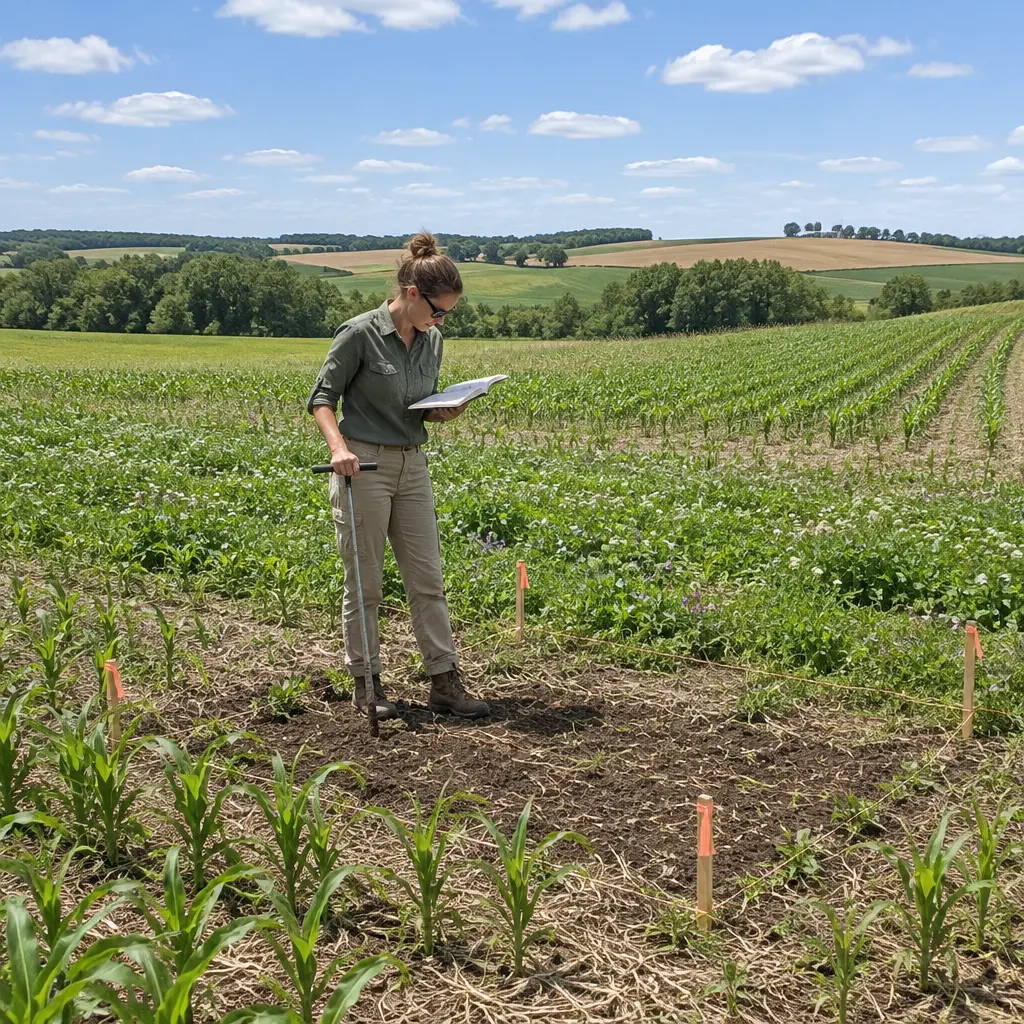
Soil health reporting measures how well soil sustains biological productivity, supports environmental functions, and maintains plant, animal, and human health. Integrating soil indicators into environmental, social, and governance (ESG) reporting alongside carbon accounting gives investors and companies a fuller view of land-related risks and outcomes: carbon data tracks greenhouse-gas emissions and removals, while soil metrics show whether the land systems behind those figures are resilient and improving. The need is material: the Food and Agriculture Organization (FAO) estimates that 33% of the world’s soils are moderately to highly degraded, and the Intergovernmental Panel on Climate Change (IPCC) identifies soil as a major terrestrial carbon store. This article explains soil-health metrics, their relationship to carbon accounting, measurement and assurance challenges, and practical steps for reporting them credibly.
ESG Reporting Soil Health Metrics: Definition and Scope
ESG reporting is the disclosure of an organization’s environmental, social, and governance impacts, risks, and performance. Soil-health metrics are measurable indicators used to assess soil condition and function. The FAO’s definition of soil health centers on the soil’s continuing capacity to function as a living system, sustaining plants, animals, and people. In ESG practice, this means reporting more than acreage or carbon totals: organizations can disclose indicators of soil structure, nutrient cycling, water regulation, biological activity, erosion, and contamination, together with the management practices that influence them.
Soil health is not captured by one universal score. Its condition varies with soil type, climate, land use, and intended function, so a credible disclosure identifies the indicator, sampling method, baseline, reporting boundary, and direction of change. This distinction matters because a carbon gain in one field or year does not, by itself, demonstrate better soil structure, biodiversity, or water retention.
Physical soil indicators
Physical indicators describe the soil’s structure and ability to absorb, store, and transmit water and air. Common measures include aggregate stability, bulk density, infiltration rate, compaction, soil depth, and erosion. These attributes affect root growth, runoff, and susceptibility to drought. For example, a company sourcing agricultural commodities may track infiltration and erosion on sampled supplier fields, reporting the percentage of monitored area that meets a defined threshold and explaining how the threshold was selected.
Chemical soil indicators
Chemical indicators measure soil composition and nutrient availability. Examples include soil organic carbon, pH, electrical conductivity, nitrogen, phosphorus, potassium, and selected contaminants. Results require context: nutrient concentrations that are appropriate for one crop or soil may not be suitable for another. Reporting should specify sampling depth, laboratory method, units, and whether results are measured, modeled, or estimated. Where fertilizer use is material, soil-test results can help explain nutrient-management performance rather than relying on application rates alone.
Biological soil indicators
Biological indicators assess living organisms and biological processes in soil. They can include microbial biomass, earthworm abundance, soil respiration, enzyme activity, and measures of soil biodiversity. The U.S. Department of Agriculture’s Natural Resources Conservation Service (USDA NRCS) emphasizes that soil functions emerge from interactions among physical, chemical, and biological properties. Biological measurements can be informative, but they are sensitive to season, recent weather, sampling design, and laboratory protocol; companies should therefore avoid treating a single observation as a definitive measure of ecosystem recovery.
Carbon Accounting Connects to Soil Health Metrics
Carbon accounting quantifies greenhouse-gas emissions and removals within a defined organizational or value-chain boundary. Soil health reporting complements it by describing the condition and management of the land associated with those flows. The connection is direct but not interchangeable: soil organic carbon is both a soil indicator and a carbon stock, while erosion, compaction, nutrient imbalance, and biological decline can affect the durability and reliability of carbon outcomes.
The IPCC’s 2019 Refinement to the 2006 Guidelines for National Greenhouse Gas Inventories provides methods for estimating emissions and removals from land use and management, including changes in soil carbon. At the global scale, the IPCC’s 2022 Sixth Assessment Report describes soils as containing roughly 2,500 gigatonnes of carbon, making soil a critical component of the climate system. That global estimate is not a corporate accounting figure; organizations need site- and boundary-specific data and must distinguish measured changes from modeled estimates.
Soil organic carbon and carbon-stock change
Soil organic carbon (SOC) is carbon stored in decomposed plant, animal, and microbial material within soil. SOC concentration is commonly reported as a proportion of soil mass, whereas a carbon stock accounts for concentration, bulk density, sampling depth, and the area represented. Because these measures are not equivalent, reporting only a percentage can obscure whether the total stock has changed. Comparisons over time should use consistent sampling locations and depths or a defensible equivalent-soil-mass approach, disclose uncertainty, and state whether estimates include inorganic carbon.
Greenhouse-gas removals, emissions, and durability
Agricultural soils can store carbon under some conditions, but management changes may also affect nitrous oxide and methane emissions. A carbon report that counts soil-carbon gains without considering relevant emissions may overstate net climate benefit. The GHG Protocol’s Land Sector and Removals guidance, published in 2023, provides a framework for companies to account for land-related emissions and removals, including issues of traceability, monitoring, and reversal risk. ESG disclosures should identify the accounting method, time period, permanence assumptions, and treatment of uncertainty rather than presenting removals as automatically permanent.
Why carbon alone is an incomplete land-performance measure
Carbon totals describe one important outcome, but they do not reveal every ecological or operational condition. For example, a site may report increased SOC while still experiencing nutrient loss or localized erosion. Conversely, practices that improve infiltration or reduce compaction may produce valuable resilience benefits before a detectable carbon-stock change appears. Pairing carbon data with physical, chemical, and biological indicators helps users distinguish climate claims from broader soil stewardship performance.
Measurement and Assurance Make Soil Disclosures Credible
Soil measurements vary across sites and seasons, and field sampling is costly relative to many operational data streams. Credible ESG reporting therefore treats methodology as part of the result. The company should define the land boundary and population represented, disclose sampling frequency and depth, explain laboratory and modeling methods, and report uncertainty and data coverage. The European Union’s Corporate Sustainability Reporting Directive (CSRD) and European Sustainability Reporting Standards (ESRS) have increased the importance of material, documented sustainability information for in-scope companies; ESRS E4 addresses biodiversity and ecosystems, while ESRS E1 covers climate change. Applicable reporting obligations depend on jurisdiction, company status, and evolving implementation rules.
Sampling design, baselines, and comparability
A baseline is the reference condition against which later results are assessed. It should be established before, or as close as practical to, a material management intervention and should reflect the range of soil types and land uses in the reporting boundary. Stratified sampling—grouping fields by relevant characteristics before selecting sample locations—can improve representativeness. Companies should also disclose whether samples were collected at comparable times of year and under comparable conditions, because moisture, temperature, and management timing can affect results.
Models, remote sensing, and field verification
Models and remote sensing can extend monitoring across large landscapes, while laboratory analysis and field observations provide site-level evidence. Neither substitutes automatically for the other. Satellite imagery may help identify vegetation cover or land-use change, but it does not directly measure every soil property. A robust system documents model assumptions, calibration data, spatial resolution, and validation against field samples. The FAO’s Global Soil Partnership and its soil information initiatives illustrate the broader need for consistent data systems, while company programs should make clear which outputs are observations and which are estimates.
Assurance, traceability, and data quality
Assurance is an independent assessment of whether reported information follows the stated criteria and is supported by evidence. For soil-health disclosures, evidence may include georeferenced sample records, laboratory quality controls, chain-of-custody documentation, farm-management records, and model validation. Companies relying on suppliers should explain how land parcels are identified, how data gaps are handled, and what proportion of the relevant sourcing area is covered. Clear controls reduce the risk of double counting, selective reporting, or claims that cannot be traced to the land concerned.
ESG Implementation Uses Materiality, Targets, and Examples
A practical soil-health reporting program begins with materiality: identifying where soil condition affects business performance, environmental impacts, or stakeholders. Exposure can be especially relevant to food, agriculture, forestry, mining, construction, and companies with land-intensive supply chains. The program should then connect indicators to management decisions, targets, and outcomes. The FAO’s 2015 Status of the World’s Soil Resources report estimated that 33% of global soils were moderately to highly degraded, underscoring why land condition is relevant to food security, water regulation, and ecosystem resilience as well as carbon.
Select indicators that fit the business and landscape
Indicator selection should follow the organization’s impact pathways and local conditions. A row-crop supply chain might prioritize SOC, erosion risk, nutrient balance, and ground cover; a mining operation may focus on topsoil handling, compaction, contamination, and rehabilitation success. A company should avoid publishing a long list of disconnected metrics. A concise indicator set with transparent rationale, measurable baselines, and defined boundaries is generally more decision-useful than an aggregate score whose components cannot be examined.
Set targets and disclose progress transparently
Targets translate measurement into accountability. A useful target states the indicator, baseline year, geographic or supplier boundary, target year, and method for evaluating progress. For instance, a company could commit to increasing the share of monitored farmland using verified erosion-control practices while separately tracking soil-cover or infiltration outcomes. It should report both the area covered by practices and measured environmental results: adoption is an activity, not proof that soil condition improved. Any missed targets, methodological changes, or material data gaps should be explained.
Real-world application: agricultural supply chains
In a commodity supply chain, a buyer can combine farm-level management records with periodic soil sampling and carbon estimates. The resulting disclosure might show the percentage of sourcing hectares assessed, trends in SOC stocks, erosion-control adoption, nutrient-management practices, and uncertainty ranges. Programs such as the USDA NRCS Soil Health Principles promote practices including minimizing disturbance, maintaining soil cover, keeping living roots, and increasing diversity. These principles are practical management guidance, not a guarantee of a specific carbon or biodiversity outcome; local monitoring is needed to verify results.
Visualizing soil and carbon performance
A useful ESG chart can plot annual SOC stock estimates alongside sampling uncertainty and the percentage of land assessed. A companion dashboard can show erosion risk, ground cover, nutrient indicators, and sampling coverage by region. Showing coverage and uncertainty alongside headline results helps readers distinguish a measured trend from a change caused by expanded sampling or revised methods. Where figures are not directly comparable, the report should label the break in series rather than implying uninterrupted progress.
Conclusion: Soil Health Metrics Strengthen ESG Carbon Accounting
Soil-health metrics broaden ESG reporting beyond greenhouse-gas totals by showing whether land is functioning, resilient, and responsibly managed. Physical, chemical, and biological indicators complement SOC accounting, while careful boundaries, consistent sampling, transparent models, and independent assurance make disclosures more credible. With soil degradation affecting an estimated 33% of soils globally and soils holding an enormous share of terrestrial carbon, the subject is material to climate, water, biodiversity, food production, and business resilience.
Organizations should start by mapping material land exposure, choosing a small set of context-specific indicators, establishing defensible baselines, and reporting coverage and uncertainty alongside results. They should also align carbon methods with recognized accounting guidance and avoid implying that carbon gains alone prove overall soil recovery. For further action, review FAO soil resources, USDA NRCS soil-health guidance, the IPCC inventory methods, and the GHG Protocol’s land-sector guidance when designing a reporting system.
Sources: Food and Agriculture Organization of the United Nations, Status of the World’s Soil Resources, 2015, https://www.fao.org/3/i5199e/i5199e.pdf; Intergovernmental Panel on Climate Change, Climate Change and Land: An IPCC Special Report, 2019, https://www.ipcc.ch/srccl/; Intergovernmental Panel on Climate Change, 2019 Refinement to the 2006 IPCC Guidelines for National Greenhouse Gas Inventories, 2019, https://www.ipcc-nggip.iges.or.jp/public/2019rf/; Greenhouse Gas Protocol, Land Sector and Removals Standard, 2023, https://ghgprotocol.org/land-sector-and-removals-guidance; U.S. Department of Agriculture, Natural Resources Conservation Service, Soil Health, https://www.nrcs.usda.gov/conservation-basics/natural-resource-concerns/soils/soil-health; European Commission, Corporate sustainability reporting, https://finance.ec.europa.eu/capital-markets-union-and-financial-markets/company-reporting-and-auditing/company-reporting/corporate-sustainability-reporting_en.