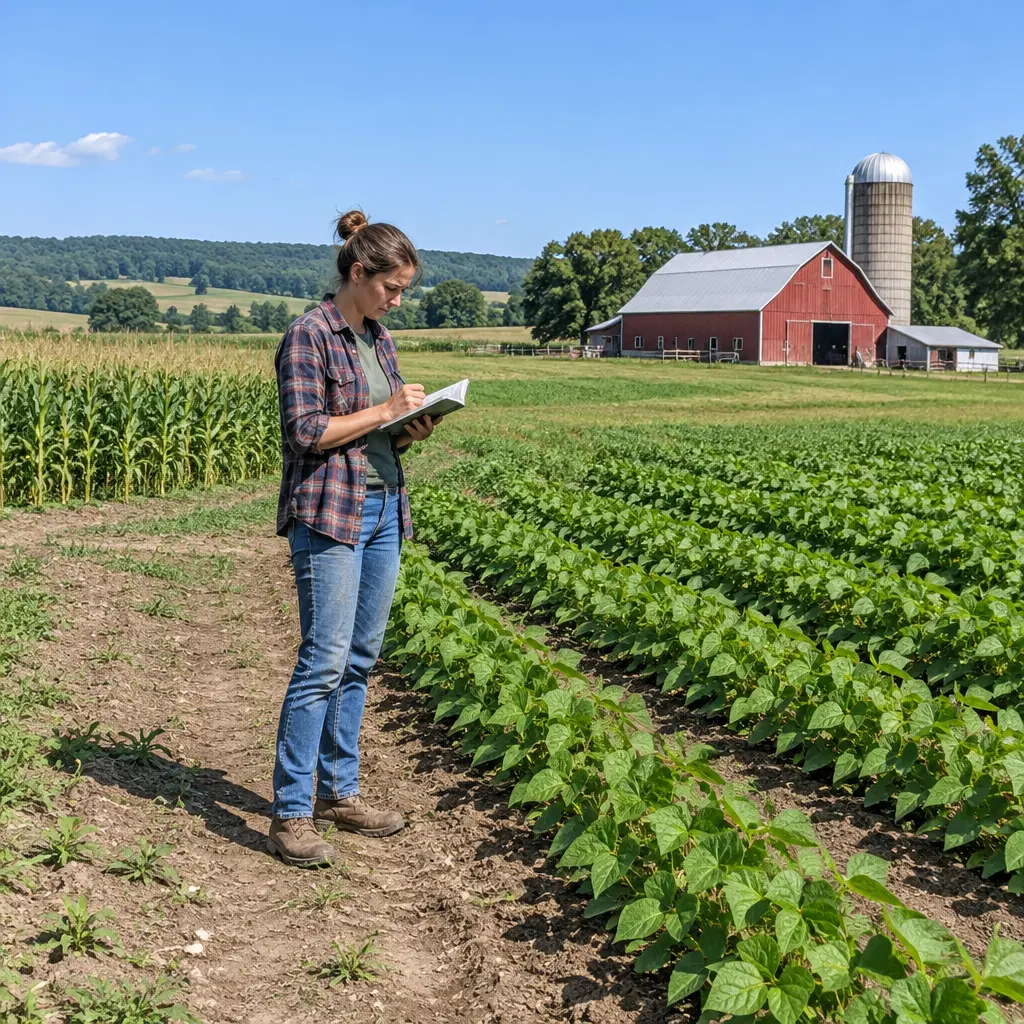
Farm transition economics is the study of how a farm’s costs, revenues, and production risks change as it moves from conventional practices toward organic certification. During the certification waiting period, a farm may incur new costs or face yield changes before it can sell crops as certified organic. The risk is real but varies by crop, soil, weather, and management: a 2019 meta-analysis found organic yields averaged 19.2% below conventional yields across the studies it reviewed, while research also found that diversified rotations and multi-cropping narrowed the gap. Those broad comparisons are not forecasts for an individual transitioning farm. A sound estimate separates temporary yield effects from certification rules, organic price premiums, transition costs, and cash-flow timing.
Certification waiting periods define the transition yield-risk window
The U.S. Department of Agriculture’s National Organic Program (NOP) requires land used for organic crops to have had no prohibited substances applied for at least three years immediately before harvest of an organic crop. This is a land-history requirement, not a universal three-year period in which yields must fall. A farm can adopt organic practices during the waiting period, but crops from land that has not met the requirement cannot be marketed as organic.
That distinction creates the central economic exposure: the farm may pay for transition practices while receiving conventional prices, unless it can secure another verified market or premium arrangement. Yield risk is one part of the calculation; the lost opportunity to receive an organic premium can be equally important. The USDA Economic Research Service has reported that organic price premiums vary substantially by commodity and market conditions, so a farm should not assume that a single national premium applies to its crop.
Yield dip: a farm-specific change, not a certification penalty
A yield dip is a reduction in marketable output per unit of land relative to a suitable baseline. Certification itself does not impose a yield reduction. Changes can arise as growers stop using prohibited inputs, rebuild fertility, alter rotations, or learn new weed, pest, and disease-control methods. Conversely, yields may remain stable or improve where existing practices already align with organic production, or where soil and rotation changes address limiting factors.
A useful baseline is the farm’s own recent, crop-specific yield history, adjusted for weather and other unusual conditions—not a national organic-versus-conventional average. For context, Seufert, Ramankutty, and Foley’s 2012 global meta-analysis estimated organic yields were 25% lower on average, while Ponisio and colleagues’ 2015 meta-analysis estimated a 19.2% gap and found that crop rotation and multi-cropping reduced it. The differing results reflect study selection, methods, crops, and management; neither figure predicts an individual farm’s transition outcome.
Certification timing and market eligibility
The waiting-period clock depends on documented land-use history and prohibited-substance use. Producers should confirm field eligibility, recordkeeping requirements, and the timing of certification with a USDA-accredited certifying agent. Organic certification applies to compliant production and handling systems; it does not guarantee a buyer, a price premium, or a particular yield.
A transitional crop may still be sold through conventional channels, but producers should not label it organic before meeting the applicable requirements. Some buyers or programs may offer transitional-market arrangements, but their standards and payment terms are private and can differ from USDA organic certification. Treat any such revenue as conditional until the buyer confirms eligibility, volume, quality specifications, and price in writing.
Transition yield risk depends on crop, soil, and management
Transition yield risk is the chance that output or saleable quality will differ from the farm’s expected baseline while production practices and markets change. It is best assessed by field and crop rather than by applying one percentage to the whole operation. The main risk categories are biological and operational, financial and market-related, and informational: uncertainty about how a specific field will respond.
Biological and operational risks
Weed pressure, nutrient availability, pest cycles, disease, and planting or harvest timing can all affect yield. Replacing quick-acting synthetic fertility with organic nutrient sources may require advance planning, while mechanical weed control depends on suitable equipment, labor, and field conditions. A wet spring, for example, can narrow the time available for cultivation and increase weed competition. These risks interact: a delayed operation can compound both yield loss and harvest-quality problems.
Soil condition and rotation history shape the scale of the challenge. A diversified rotation can interrupt pest and disease cycles and provide opportunities for cover crops or fertility-building crops, but those benefits may take time and can involve short-term opportunity costs. The 2015 meta-analysis by Ponisio and colleagues supports the value of rotation and multi-cropping for narrowing average organic yield gaps, though the result should be treated as evidence about systems, not a guaranteed farm-level response.
Financial and market risks
Transition cash flow combines possible lower or more variable output with costs for seed, fertility inputs, equipment, labor, certification, testing, and recordkeeping. At the same time, the farm may not yet qualify for organic pricing. A crop can therefore produce a positive gross margin and still leave the business short of cash if payment arrives after expenses fall due.
The USDA Risk Management Agency offers Whole-Farm Revenue Protection, which can cover revenue from diverse farm commodities subject to program rules and eligibility. USDA also administers the Organic Certification Cost Share Program, which can reimburse eligible certification expenses up to program limits. These programs can reduce specific exposures, but they do not insure every transition loss or replace a farm-specific budget. Confirm current program terms with the relevant agency or service provider.
Information and estimation risk
Estimation risk arises when the farm lacks reliable field records, comparable local benchmarks, or a clear account of transition costs. A whole-farm average may hide a serious problem in one crop or field, while an unusually poor conventional year can make the transition look safer than it is. Track yield, grade, input use, labor hours, and price by field and crop, and note weather and management changes that could explain results.
The USDA National Agricultural Statistics Service’s organic surveys and USDA Economic Research Service market reports can provide context on certified production and commodity markets. Their data are useful for comparison, but local buyer bids, regional extension budgets, and the farm’s own records are more relevant to a transition decision.
Farm transition economics measures the yield dip in dollars
Farm transition economics translates production uncertainty into expected revenue, costs, and cash needs. A practical method compares a baseline scenario with a transition scenario, then tests a downside case. The calculation should be repeated by crop and field where records allow, because yield, price, and cost responses differ across the operation.
Calculate the yield and revenue gap
Start with the following calculations:
- Yield change (%) = (transition yield − baseline yield) ÷ baseline yield × 100.
- Baseline gross revenue = baseline yield × expected conventional price.
- Transition gross revenue = transition yield × expected transition-period price.
- Revenue gap = baseline gross revenue − transition gross revenue.
For example, suppose a farm’s baseline is 150 bushels per acre at $5 per bushel, or $750 per acre. If a planning scenario assumes 135 bushels per acre and the same price, transition gross revenue is $675 per acre—a $75-per-acre, 10% decline. This is an illustration, not a yield forecast. If the crop is not yet eligible for organic marketing, do not apply an organic premium unless a buyer has confirmed a separate, lawful transitional-market arrangement.
Include variable costs, fixed costs, and transition expenses
Gross revenue is not profit. Estimate contribution margin by subtracting crop-specific variable costs, then include additional transition costs and the effect of fixed costs on the farm’s ability to meet obligations. Relevant expenses can include cover-crop seed, organic amendments, cultivation passes, extra labor, new or modified equipment, certification, testing, storage, and marketing. Avoid counting a cost twice—for example, if added cultivation is already included in machinery and labor estimates.
A useful comparison is transition contribution margin minus baseline contribution margin, followed by a separate cash-flow schedule. This distinguishes a crop that remains economically viable but has a timing problem from one that is unprofitable at the expected yield and price.
Build scenarios rather than relying on one average
Use at least three cases: an expected case, a downside case, and an upside case. For each, vary yield, price, and costs using farm records, local agronomic advice, and buyer information. A downside case might combine a modest yield reduction with higher weed-control costs and no price premium; it should reflect plausible local conditions rather than an arbitrary worst case.
A sensitivity table can show how net revenue changes when yield falls by 5%, 10%, or 20%, and when prices or input costs move. A simple chart with yield on the horizontal axis and net revenue per acre on the vertical axis can reveal the break-even yield. Label it as a planning scenario, not a prediction, and show both conventional-price and any documented transition-market cases.
Transition planning reduces avoidable yield and cash-flow losses
Risk management cannot eliminate weather or biological uncertainty, but it can reduce avoidable losses and improve the farm’s ability to absorb them. The strongest plans combine agronomic preparation, market confirmation, cash reserves, and records that allow assumptions to be updated after each season.
Phase acreage and protect the farm’s cash engine
Transitioning a portion of acreage at a time can limit exposure while the operator tests rotations, equipment, and labor needs. The appropriate share depends on the farm’s financial capacity and crop mix; there is no universal safe percentage. Preserve enough reliable revenue to meet debt service and operating obligations, and model the consequences of moving additional fields into transition.
Match rotations and inputs to field conditions
Work with a qualified agronomist, extension specialist, or experienced organic producer to develop field-specific rotations, fertility plans, and weed-control timing. Soil tests, field histories, and scouting can help distinguish nutrient limitations from weather or pest effects. Secure seed, approved inputs, machinery, and labor before critical field windows, and verify that purchased materials comply with the applicable organic rules through the certifier.
Secure buyers and financing before harvest
Discuss volume, quality, delivery dates, storage, and price terms with prospective buyers well before harvest. If a buyer offers a transitional premium, document the standard being used and the conditions for payment. Ask lenders to review a multiyear cash-flow forecast that includes the waiting period, plausible yield variation, and delayed or uncertain revenue. Investigate insurance and cost-share eligibility early, since application deadlines and documentation requirements matter.
Conclusion: yield-dip risk is measurable, but not universal
Certification waiting periods create an economic gap between adopting new practices and qualifying for organic marketing, but they do not automatically cause yields to fall. Research meta-analyses report average organic yield gaps, with results affected by crop and management; those figures are context, not a farm forecast. Transition yield risk is best evaluated through field-level records, realistic yield and price scenarios, full cost accounting, and cash-flow planning.
Farmers considering transition should confirm land eligibility and certification timing with an accredited certifier, build a multiyear budget with local technical advice, and verify buyer and assistance-program terms before relying on them. Better measurement can turn an uncertain waiting period into a managed investment decision—and help farms, lenders, and advisers distinguish a temporary yield challenge from an unsustainable business plan.
Sources: U.S. Department of Agriculture, National Organic Program, 7 CFR § 205.202, Land requirements, https://www.ecfr.gov/current/title-7/subtitle-B/chapter-I/subchapter-M/part-205/subpart-C/section-205.202; Seufert, Verena, Navin Ramankutty, and Jonathan A. Foley, “Comparing the Yields of Organic and Conventional Agriculture,” Nature, 2012, https://doi.org/10.1038/nature11069; Ponisio, Lauren C., et al., “Diversification Practices Reduce Organic to Conventional Yield Gap,” Proceedings of the Royal Society B, 2015, https://doi.org/10.1098/rspb.2014.1396; U.S. Department of Agriculture, Economic Research Service, Organic Agriculture, https://www.ers.usda.gov/topics/natural-resources-environment/organic-agriculture/; U.S. Department of Agriculture, Risk Management Agency, Whole-Farm Revenue Protection, https://www.rma.usda.gov/policies-and-procedures/whole-farm-revenue-protection; U.S. Department of Agriculture, Agricultural Marketing Service, Organic Certification Cost Share Program, https://www.ams.usda.gov/services/grants/occsp; U.S. Department of Agriculture, National Agricultural Statistics Service, Organic Surveys, https://www.nass.usda.gov/Surveys/Guide_to_NASS_Surveys/Organic_Production/.